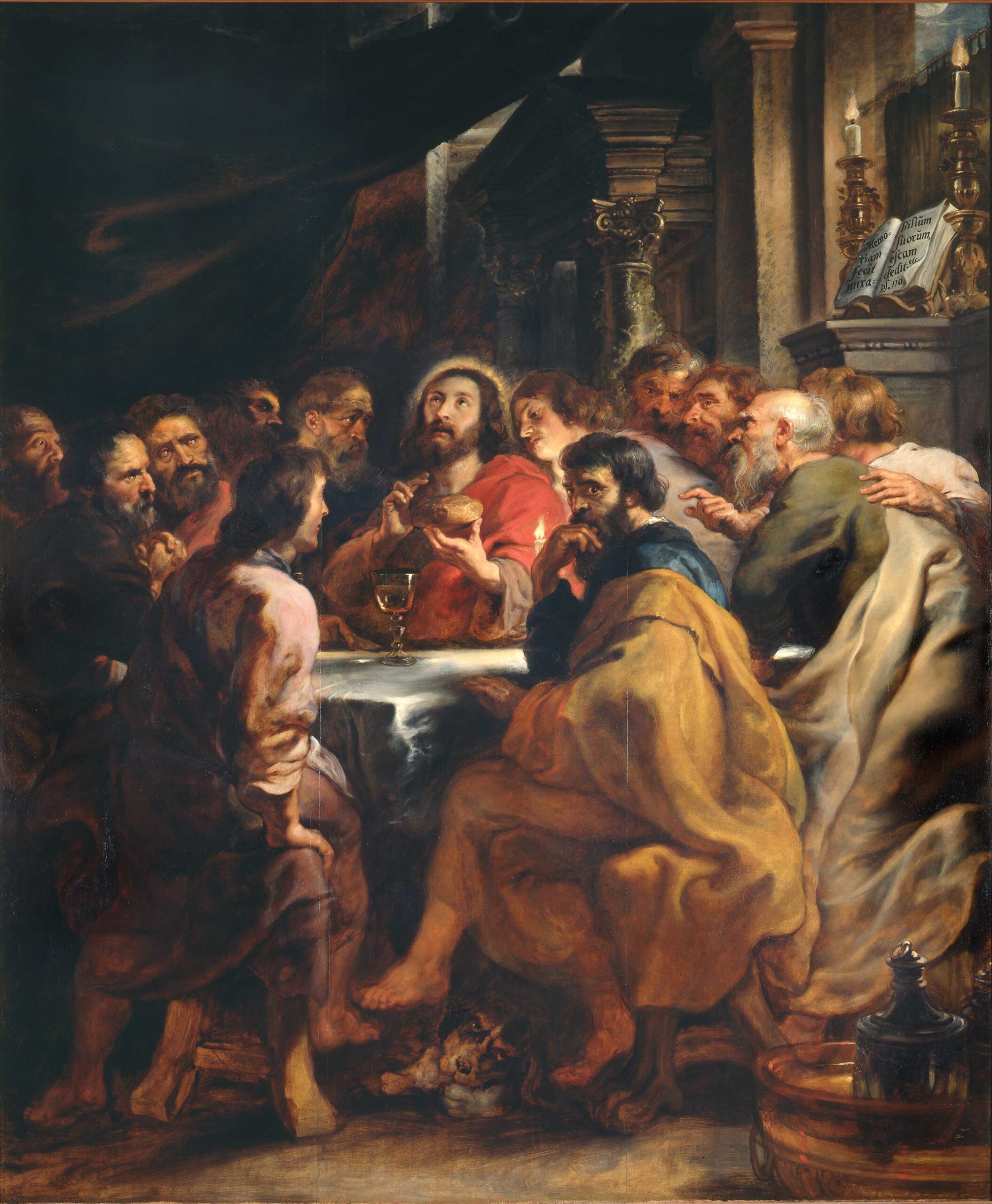
Twelfth Sunday in Ordinary Time – June 23

mantegna_dead_christCentral Idea: Salvation comes by way of the Cross. Doctrine: Taking up one’s daily cross – Christian holiness by way of the Cross. Practical Application: The necessary virtues of fortitude and temperance.

For the Lectionary 96 readings click here.

Central Idea: Salvation comes by way of the Cross

  • Christ redeemed us from sin through his Cross, that is by what he suffered.
  • Zechariah foresees Christ, this Son of David, whom his own people will put to death but who will become a “fountain” to purify from sin. His own people will mourn him like a lost only son.
  • Zechariah foresees the piercing of the Son of David. When Christ was pierced with a lance by that Roman soldier, out flowed blood and water, “a fountain to purify from sin and uncleanness.” Christ’s followers lost Him who was the only son and firstborn, not only of his mother, the Blessed Virgin Mary, but also of God the Father.
  • As the Psalm tells us, the condition of anyone who follows God is to thirst for him and to offer him thanks and praise because of his power, glory, and kindness.
  • The human being has an innate desire for God. This can be seen in the experience that we endlessly seek satisfactions but nothing in this life can fully satisfy us.
  • Often at the beginning of our faith journey, God gives the soul sweetness and consolation, to draw us to him. Also, often, God withdraws those blessings to purify our wills.
  • Abraham is our father in faith. God promised Abraham at the beginning of his faith journey that he would make him a universal blessing. St. Paul reveals a dimension of that promise and something unheard of in the ancient world: The radical equality of every human being in Christ. Every person who is baptized into Christ has the same dignity. Men are not superior to women; the Jew is not superior to the Gentile; the free person is not superior to the slave.
  • To be baptized into Christ means to be transformed from within—that is what God does. It also means to cooperate in that transformation by following him in his Passion—that is what we do.
  • If you wish to be a follower of Christ, you must endure your own suffering, rejection, and death, in order to enjoy your own resurrection.
  • This means self-denial, because no one naturally chooses suffering. This self-denial is daily because every day we are drawn away from God in small and big ways. But we can always return to Christ, that fountain of forgiveness.
  • Sacrifice, even of good things, is the cost of salvation. But the end is to “on the third day be raised,” to lose your life to save it.

Doctrine: Taking up one’s daily cross–Christian holiness by way of the Cross

  • We are called to holiness, achieved through devotion to God and service to neighbor in union with Christ. (CCC 2013-2014)
  • “The way of perfection passes by way of the Cross. There is no holiness without renunciation and spiritual battle. Spiritual progress entails the ascesis and mortification that gradually lead to living in the peace and joy of the Beatitudes:
    • [As St. Gregory of Nyssa put it] “He who climbs never stops going from beginning to beginning, through beginnings that have no end. He never stops desiring what he already knows.” (CCC 2015)
  • When we make that conscious decision to follow Christ, wouldn’t it great if our lives suddenly became easy and problem-free? Instead what happens is life seems to become harder. This why we need ascesis, the practice of self-discipline in the spiritual life.
    • You can’t think anything you want (like imagining taking revenge), look at anything you want (like nudity), eat and drink anything you want, say anything you want (like lies).
    • Instead you are asked to think things that are hard (like forgiving past slights), look at things you don’t want to face (like your unconfessed sins), say things that are hard (like “I’m sorry”), and do things that are difficult (like give time, talent, and treasure) out of charity.
  • As Fr. Robert Spitzer points out, this taking up our cross makes us real partakers in the life of Christ. We prove our love and loyalty. We enhance our own dignity.[1]
  • Two of the key virtues that are required for taking up one’s cross are fortitude and temperance.

Practical Application: The necessary virtues of fortitude and temperance

  • Fortitude is courage in the face of fear and toughness in the face of pain. Temperance is self-control when presented with any pleasure.
  • While we should not foolishly throw ourselves into danger unnecessarily, and while there are situations we ought to avoid and even run from, whenever there is something we have a duty to do but are afraid, God asks us to face it. That is courage.
  • God also asks us to endure pain and toil when we have a duty to act or to keep on acting.
  • The Passion of Christ is the supreme example of courage and perseverance endured for love. In agonizing fear, Christ sweated blood in the Garden of Gethsemane. Then he endured that cruel catalog of suffering. To take up your cross and follow him means courage and toughness for love.
  • Seeking pleasure is natural to us and we can’t live without it. But the way of holiness also means rejecting evil pleasures like carnality, drunkenness, cruelty, and domination. This is one dimension of temperance.
  • Temperance also asks us to forgo even innocent pleasures if love of God or neighbor requires it. For example, the Church asks us to do some act of penance every Friday. If you chose to fast, likely you will suddenly be thinking of all the delicious things you won’t be enjoying. That calls for temperance.
  • A mother with young children might desire to just sit down and enjoy a quiet cup of tea, but her love and care for her children keep her up on her feet attending to their needs. By doing so, she’s growing in fortitude and temperance, carrying her daily cross—sometimes light and sometimes quite heavy—and cooperating in her own salvation and that of her family.
  • Fortitude and temperance are important virtues for any person who wants to accomplish anything. They are necessary for each follower of Christ in order to obey the Lord’s new commandment to love one another with a spirit of sacrifice, taking up one’s cross daily.

Comments

  • Please leave a comment. Let’s get a discussion going!
If you enjoyed this article, Get email updates (It’s free)

Eleventh Sunday in Ordinary Time – June 16

Brokenwomankissingjesussfeet

Central Idea: God gladly forgives the sins of the contrite of heart. Doctrine: Contrition. Practical Application: Daily examination of conscience.

To view Lectionary 93, click here.

2 Sm 12:7-10, 13, PS 32:1-2, 5, 7, 11, Gal 2:16, 19-21, LK 7:36-50

  • St. Paul reminds us we are to avoid evil and do good.
  • But we have something wrong with us—the Church names it Original Sin—which keeps inclining us to sin.
  • The drama of our lives is the battle between our aspirations to do good and the pull of sin. We need the graces Christ won for us and offers us, especially through the Sacraments.
  • Out of lust for her beauty, King David committed adultery with Bathsheba, the wife of his most loyal soldier Uriah, and got her pregnant. David tried various means of covering up his sin and when they failed he found a way to get Uriah killed in battle. When the prophet Nathan helped the king come to his senses, King David declared, “I have sinned against the LORD.”
  • As Christ reclined at the banquet, the woman washed his feet with her tears, dried them with her hair, and anointed them with perfumed oil.
  • Taken together, the “sinful” woman and King David make a perfect model of contrition. David made a naked confession, “I have sinned against the LORD.” She showed sorrow for her condition with her tears. Neither said a word on his or her own behalf. No excuses. No elaborate explanations. No blaming others.
  • We the Baptized live “in Christ.” That is, with his grace we try to do good and avoid evil, not to save ourselves or justify ourselves, but because that is what children of God should do.
  • When a person sincerely asks God to forgive his sins, God forgives. David confessed his sin to God. God took away the guilt of his sin. David was freed and rejoiced. No doubt so was the woman.
  • And when we fail, we turn in sorrow to our good God who readily forgives us. He has even given us a Sacrament for that, Penance.

 Doctrine: Contrition

  • The Sacrament of Reconciliation’s fundamental structure “comprises two equally essential elements: on the one hand, the acts of the man who undergoes conversion through the action of the Holy Spirit: namely, contrition, confession, and satisfaction; on the other, God’s action through the intervention of the Church” (CCC 1448).
  • Here we will focus on one of the acts of the individual: contrition.
  • Contrition is “sorrow of the soul and detestation for the sin committed, together with the resolution not to sin again.” (CCC 1451) We saw the deep sorrow in the woman who washed Christ’s feet.
  • In regard to the resolution not to sin again, the idea some have that Catholics think you can go out and do whatever you want, and then confess it, and then go out and do it again, is insane. There must be a real resolution to not do it again.
  • The Church recognizes two kinds of contrition. Perfect contrition arises out of loving God above all else. Such contrition remits venial sins; it also obtains forgiveness of mortal sins if it includes the firm resolution to have recourse to sacramental confession as soon as possible” (CCC 1452).
  • Imperfect contrition is also a gift of grace and is “born of the consideration of sin’s ugliness or the fear of eternal damnation and the other penalties threatening the sinner.” This sorrow is not perfect because it grows out of fear. Still it is a good thing because it “can initiate an interior process which, under the prompting of grace, will be brought to completion by sacramental absolution.” With imperfect contrition, the grave sin is not forgiven before sacramental absolution. (CCC 1453)
  • If you feel guilty when you do wrong, consider yourself fortunate, because your conscience and heart are working properly. That guilt is there to lead you to contrition.

Practical Application: Daily examination of conscience

  • The Catechism tells us we ought to prepare for the Sacrament of Reconciliation by “an examination of conscience made in light of the Word of God” (CCC 1454)
  • A practical tool that Christians have discovered to improve in their moral lives is the examination of conscience, not simply before going to Confession but every day.
  • At the end of the day, but not so late that you are nodding off asleep, you have a dialogue with Our Lord about how your day has gone. There are many ways of doing this self-evaluation. One simple method is to ask yourself these three questions:
    • What went well today? This will elicit gratitude in you.
    • What went badly today? This should result in contrition.
    • What could I do better tomorrow? This gives you the basis for a practical resolution.
  • The examination of conscience is a way to help you improve, rather than to stay in the same place or even to deteriorate.
  • The daily examination should end with an act of contrition, either a formal one like you learned as a child or in your own words.
  • If you make a few cryptic notes about the things that went badly, you may begin to see the patterns of your own behavior that might be perfectly obvious to others but invisible to you. You also will have done most of the work of preparing for a good Confession.
If you enjoyed this article, Get email updates (It’s free)

Tenth Sunday in Ordinary Time – June 9

miracle_of_the_widow_of_nain_Mario Minniti 1620

Central Idea: Love your neighbor, not “humanity.” Doctrine: The New Evangelization. Practical Application: Participation in the New Evangelization

  • Our Lord limited his time on earth: About thirty years of ordinary life, about three years of preaching and miracles, about three hours on the Cross.
  • He also limited his presence to in and around Israel.
  • Thus, though Our Lord redeemed every human being—past, present, and future—he only physically came to Israel for those few years and only interacted with those people with whom he came into contact. In other words, he accepted the physical limits that are part of our own lives.
  • In today’s Gospel, we hear of one interaction witnessed by two large crowds: Jesus Christ raising the son of the Widow of Nain from the dead and giving him back to his mother for her support.
  • St. Paul would have liked to preach his Gospel to every person on earth but here he could only address the Galatians who had gotten to know Jesus Christ through him.
  • The great prophet Elijah might have liked to raise every widow’s son from the dead but he only came to the aid of the Widow of Zarephath to give her back her son.
  • We are not disembodied spirits who can go anywhere and be in multiple places at once. Like Jesus encountering the widow, we can only directly serve those people with whom we come in contact. These are the widow and young man for us.
  • There is a danger for us. At one and the same time, we can aspire to do good to every person on earth and yet we can ignore, or neglect, or hurt the people right around us. We can think we are doing good for everyone and not be doing any actual good for anyone.
  • There is nothing wrong with having a great love for humanity, but this love must begin with our actual neighbor. As the saying goes, “Love begins at home.”
  • As Mother Teresa put it in her Nobel lecture: “Love begins at home, and it is not how much we do, but how much love we put in the action that we do.”

Doctrine: The New Evangelization

  • Evangelization is the proclamation of the Gospel to those who have not heard it leading. It’s goal is their Baptism and their living the Christian life. This is the “old” or “original” evangelization and it is always ongoing.
  • The New Evangelization which the modern Popes have been calling for takes place in countries like our own in which the Gospel has been proclaimed, many people have accepted it and even been baptized, but many have grown cold and are in need of a reevangelization. The New Evangelization is preaching the Gospel again to those who have heard it but who have forgotten about it, who may think they don’t want to hear it, or who likely have never “really” heard it.
  • A particular difficulty in the New Evangelization is that it often needs to be done in a society which is indifferent to the Gospel or even actively opposed to it—both culturally and even in law.
    • Witness the growing intolerance toward Catholics teaching or living basic moral doctrines in regard to human sexuality.
    • Witness the effort of the government in the United States to force Catholic employers to pay for contraceptives and abortions.
    • On our part, this calls for the kind of courage the early Christians showed.
  • Who does the New Evangelization? Every one of us, especially every one of the laity. Only the laity can bring to Gospel into every corner of society. Like Our Lord, we are to bring the Gospel to those we can encounter.
  • In our society today, there are many widows in grief and many young men sick or dead due to ignorance and sin. There are many families in need of restoration.

Practical Application: Participation in the New Evangelization

  • Apostolate is the overflow of one’s interior life. Therefore, to participate in the New Evangelization, develop an interior life of intimacy with God through mental prayer and the Sacraments, especially frequent reception of the Eucharist. This will make us want to bring the Gospel to those around us and God himself will give us our “marching orders,” suggesting who to talk to and what to say.
  • Form sincere friendships with people.
  • Pray for a person and make sacrifices before trying to talk about the Faith.
  • Get to know the doctrine of the Faith better through study.
  • Related to this is apologetics or how to overcome common objections to the faith people have. Ignorance is rampant. Often people are held back by misunderstanding.
  • Leave the outcome in God’s hands. You are just an instrument. The Holy Spirit does the interior work.

To view the readings for Lectionary 90, click here.

If you enjoyed this article, Get email updates (It’s free)

The Solemnity of the Most Holy Body and Blood of Christ – June 2

bread-fish-mosaic2To view the readings for Lectionary 169, click here.

Central Idea: Christ is the eternal high priest who offers us what he offered to the Father, himself.

Gn 14:18-20

  • When Abraham met Melchizedek, God’s Chosen People consisted of only one member, Abraham himself. At the time of Moses and the giving of the Law, when those descendants of Abraham had grown into a nation, all the men were to become priests for the rest of humanity. But because of their sin of idolatry, God took this universal priesthood from them. Instead God gave his People a priesthood for just themselves, the men of the tribe of Levi, whose ministry was to offer sacrifices for Israel.
  • Yet here at the very beginning, Abraham meets this mysterious Melchizedek, king of Salem (which means peace). who is also a high priest. Moreover, he is not a pagan priest but a priest of the true God. He makes an offering of bread and wine. He acted as a mediator between God and Abraham, delivering God’s blessing to Abraham and Abraham’s blessing back to God.

Ps 110:1, 2, 3, 4

  • Christ interpreted this as a Messianic psalm about himself. God the Father said to Christ—David’s lord—that he will be a prince and will sit at the right hand of God, having conquered all his enemies. Moreover, he will be an eternal priest, like Melchizedek, that priest-king who made an offering of bread and wine on behalf of God’s people, bringing God’s blessing down to them and offering back up their thanks.
  • Abraham, the first of the Chosen People, had won a military victory over his enemies and collected the spoils of war. He gave ten percent of it to this priest of the most high God in thanksgiving.
  • Christ, the first of the new Chosen People, won the victory over his enemies, sin and death. He was both priest and victim, offering all of the spoils he won to God the most high. He now sits at the right hand of God the Father as king and priest, interceding for his people.
  • Christ’s offering was his own body and blood, which he first offered sacramentally in the form of bread and wine at the Last Supper, transforming them into his body and blood in the Eucharist.

1 Cor 11:23-26

  • Only about twenty years after the Last Supper, even before the Gospels were written down, St. Paul repeats to the Corinthians the Apostolic tradition about the Eucharist.
  • The Apostles and the men they had appointed to assist and succeed them obeyed Christ’s orders to “Do this in memory of me.”
  • At the Last Supper, Christ offered himself to the Father in an unbloody manner, transforming the bread and wine into his body and blood. The Church has always understood Our Lord’s words literally. “This is my body” means the bread is now his body, even though it still looks and tastes like bread. “This is my blood” means the wine is now his blood, even though it still looks and tastes like wine.
  • He can do this because he is God.
  • This was the same offering Our Lord made in a bloody manner in his Passion. This is the same offering every priest makes acting in the person of Christ at every Mass.
  • This offering is the New Covenant, the solemn agreement between God and his people. The New Covenant is our redemption from sin and death and our sanctification as children of God.
  • St. Paul says, “as often as you eat this bread and drink the cup, you proclaim the death of the Lord until he comes.”
  • He means that when an Apostle or a man who is given the office of bishop or priest does what Christ commanded with bread and wine, saying those words, and then when we consume the body and blood of Christ, we are proclaiming the Gospel. The essence of the Gospel is Christ the Lord himself. Christ is God Incarnate who lived, taught, worked miracles, underwent his Passion and Death on the Cross, rose from the dead, ascended into heaven, intercedes for us, and will come again to judge the living and the dead.

Lk 9:11b-17

  • At Mass, we are just like this crowd. We come to Christ’s Church to be taught about the kingdom of God, and to be spiritually healed through the Sacrament of Penance, and then to be fed with the miraculous bread of the Eucharist. The priest himself brings very little: some bread and wine and the desire to do what his Master did at the Last Supper. But the result is something superabundant, for all are fed and satisfied.

Doctrine: The Eucharist

  • The Eucharist is Christ himself, and Christ is the Bridegroom of his Spouse, the Church.
  • Through the Mass, in which the Eucharist is “confected”, time and space are mysteriously “opened” and the Last Supper and the Passion of Christ become present.
  • Through the Eucharist, Christ becomes physically present in the Church, keeping his promise that he would always be with us. And because the Eucharist is preserved in the Tabernacle, we can be with him anytime we want.
  • In the Eucharist, we eat the body and drink the blood of Christ in Holy Communion, and obtain everlasting life, provided we receive him worthily.
  • To receive the Eucharist worthily, one must be a baptized Catholic in a state of grace, understand what one is about to receive, and have kept the Eucharistic fast.
  • Some of the effects of a worthy reception of the Eucharist are intimate communion with Christ, deeper union with the Body of Christ, forgiveness of venial sins, and an increase in graces and virtues in the soul.
  • The Church reserves Consecrated Hosts in the Tabernacle so that the Eucharist can be brought to the sick and the faithful can worship the Blessed Sacrament outside of Mass.[1]

Practical Application: Eucharistic devotion

  • Eucharistic devotion is our thanksgiving, reparation, adoration, and petition to Christ present with us in the Blessed Sacrament.
  • We can spend a few minutes after receiving the Eucharist in silent thanksgiving.
  • We can visit Our Lord reserved in the Tabernacle. There we can silently speak with him about anything we please.
  • We can participate in Exposition of the Blessed Sacrament.
  • We can join in a Eucharistic procession. It is to be hoped that every parish holds one on this solemnity.
  • We can adore him remotely, knowing where the nearest Tabernacle is and mentally “going there”. If you hear a Catholic church bell ringing, recall that it is reminding us that Christ is there.
  • We can make spiritual communions expressing our desire to be with him and to receive him using a prayer, such as,
    • “I wish my Lord to receive you, with the purity, humility, and devotion with which your most holy Mother received you, with the spirit and fervor of the saints.”
  • While Catholics honor Mary (with hyperdulia) and the saints (with dulia), we do not worship them. We do adore or worship Christ in the Eucharist (with latria) because the Eucharist is the Incarnate Second Person of the Blessed Trinity.
  • The Catechism sums up Eucharistic devotion in the words of Pope Bl. John Paul II: “Jesus awaits us in this sacrament of love. Let us not refuse the time to go to meet him in adoration, in contemplation full of faith, and open to making amends for the serious offenses and crimes of the world. Let our adoration never cease.” (CCC 1380)

[1] The doctrinal and practical material in this post is adapted from the not-yet-published Didache Parish Series, Book 5: The Sacraments, Chapters 5 & 6.

If you enjoyed this article, Get email updates (It’s free)

The Solemnity of the Most Holy Trinity – May 26

Holy Trinity HungarianCentral Idea: Human beings have dignity in their creation and exalted dignity in their redemption. Doctrine: The Blessed Trinity. Practical Application: Living like the Blessed Trinity.

To view Lectionary 166, click here.

Central Idea: Human beings have dignity in their creation and exalted dignity in their redemption.

Prv 8:22-31 and Ps 8:4-5, 6-7, 8-9

  • The writer of the Book of Proverbs and the Psalmist use an ancient conception of the physical world but display a very modern sense of wonder toward it and human beings.
  • We can see hidden in the personified figure of wisdom the Holy Spirit at “play” in creating the world.
  • The Holy Spirit gave delight to God the Father and delighted in the human race.
  • The human being rightly possesses a sense of wonder at the natural world and toward himself.
  • We can grasp something of the order God has put into creation and our place in that order and it gives us joy.
  • Why does man have such a dignity of intellect and freedom, which gives him the rule over this world? It is because God has put it in us. This is another motive for wonder and joy.
  • The Redemption Christ won for us increases our wonder and joy.

Rom 5:1-5

  • St. Paul points out some consequences of our justification or restoration to original holiness, that is, to a right relationship with God.
  • The redeemed “stand” or are in a condition of “grace.” We are in a state of being justified by accepting the redemption won for us by Christ.
  • Our condition is peace with God. That is, we are reconciled with him, friends after having been enemies.
  • In this new state, suffering has a new meaning. Affliction helps form us into the redeemed and glorious persons God plans us to become. Affliction endured in Christ’s grace forms our character into men of integrity.
  • What we are by creation is wonderful. What we are through redemption is glorious.
  • Truly the Holy Spirits delights in mankind. Who are we to be crowned with such glory and honor?

Jn 16:12-15

  • The doctrine of the Blessed Trinity is “hidden” in the Old Testament and revealed in the New.
  • This Gospel passage is one of those places where the reality of the Trinity is revealed.
  • The Spirit of truth will take from what is Christ’s and declare it to the Apostles. What does Christ have to be communicated? Everything the Father has.
  • In the New Testament, the dogma of the Blessed Trinity is revealed without being defined. Definition will come later in the first Ecumenical Councils.

Doctrine: The Blessed Trinity

  • The central mystery of Christian faith and life is that the one God is three divine persons. (CCC 261) This is not just an amazing truth we have gotten a glimpse of because it has been revealed but it has the most impact on our actual lives.
  • We know this “secret” hidden in God because he has revealed himself as Father, Son, and Holy Spirit. (CCC 261)
  • The Father generates the Son, the Son is begotten of the Father, and the Holy Spirit proceeds from the Father and the Son.
  • The truth of the Blessed Trinity sheds light on the truth that God is Love. The Blessed Trinity in itself forms a community of three bound together by mutual love.
  • In creating the human family, God looked at his own inner life to find the design for it. God’s inner life is a loving, life-giving community: the Father and Son love one another and from their love proceeds the Holy Spirit. The family is also a loving, life-giving community: From the mutual love of a husband and wife comes a child – with the help of God.
  • The Trinitarian nature of God is hinted at in the Old Testament, for example in Genesis when God says, “Let us make man in our image” or in the passage we just heard from Proverbs about the Holy Spirit at play in the Creation. But it is explicitly revealed in the New Testament. For example at Christ’s Baptism, when Christ comes out of the water, we hear the voice of the Father speaking, and the Holy Spirit appears in the form of a dove.
  • God welcomes us into his Trinitarian life: Jesus Christ is the eternally begotten Son of God the Father. Through his Son, God the Father adopts us as spiritual sons and daughters. We are temples of the Holy Spirit.
  • The “task” of the Holy Spirit in regard to us is that he sanctifies the Church and humanity.
  • By “Baptism ‘in the name of the Father and of the Son and of the Holy Spirit,’ we are called to share in the life of the Blessed Trinity, here on earth in the obscurity of faith, and after death in eternal light” (CCC 265).
  • Does Christianity believe in three gods? No. We profess three persons. Christianity is not polytheistic, as Islam charges. We believe in the existence of only one God. Yet, we believe in the Trinity, who is one God in three divine Persons.
  • Each of the persons of the Trinity is equally God. Consubstantial (“of the same substance”) is the technical word which we recite in the revised translation of the Nicene Creed.
  • Through sanctifying grace, which we receive at baptism, we actually share in the inner, Trinitarian life of God. If we attain salvation, we will directly participate in the Beatific Vision in heaven.
  • These are some reasons the Blessed Trinity is not only the central truth of our Christian faith but also the central truth of our Christian life.

Practical Application: Living like the Blessed Trinity

  • If the Blessed Trinity is the central truth of our Christian life, it should be possible to live this truth in some way. How can we be like the Blessed Trinity?
  • One truth we can glean from the Dogma of the Blessed Trinity is that God is a social being: three Divine Persons in relationship with one another.
    • We are also social beings. We are always in relationships with other persons: as a family member, as the member of a school community, as a friend, as a spouse or parent, as the member of any number of civic associations, as a member of the Church.
    • Unlike God in whom each of the three Persons is co-equal, there is inequality in our human relationships. In some, we are dependent on the other, like a child is. In others, we and the other depend on each other, as in a friendship. In others still, the other is dependent on us, for example, when a teacher instructs a student.
  • With Sacramental grace we can live all these human relationship as communions of love that reflect God’s inner life.
  • The best idea of that inner life of God we have is from Christ. Jesus Christ is the incarnation of God’s love and he has shown us that the essence of this love is the gift of self. How does this apply to us? A Vatican II document gives us the answer: “[M]an, who is the only creature on earth which God willed for itself, cannot fully find himself except through a sincere gift of himself” (GS 24).
  • It is easy to see how sacrificial love applies when people depend on us. It may be hard to provide the sacrifice, yet when we do, we love like God loves.
  • But what about when we are the dependent ones? Even when we depend on the other, we can still give of ourselves. Some examples are obeying the just authority of the one on whom we depend, as in obeying a doctor’s orders; offering up the difficult situation, as in patiently waiting when we are hungry; being cooperative and cheerful when getting technical support over the phone; and so on. When we accept the consequences of being in a dependent position, we also have a chance to imitate Our Lord when he was a child, when he was in the wilderness for forty days, and when he was enduring his Passion.
  • So whenever we give of ourselves to another person out of love, we are being like the Blessed Trinity.
  • However, we also have the terrible freedom to be selfish. Every selfish act is not only the opposite of human love; it is also the opposite of the life of the Blessed Trinity. No one on earth likes to be around a selfish person. We can’t stand people like that. This helps us see how such behavior could exclude one from the Beatific Vision.


If you enjoyed this article, Get email updates (It’s free)

Pentecost Sunday – May 19

ww62-el-greco-pentecost-large-325x216Central Idea: The Holy Spirit gives us new life in God. Doctrine: Love and the Holy Spirit. Practical Application: A prayer to the Holy Spirit.

To view the readings for Lectionary 63, click here.

Central Idea: The Holy Spirit gives us new life in God.

Acts 2:1-11

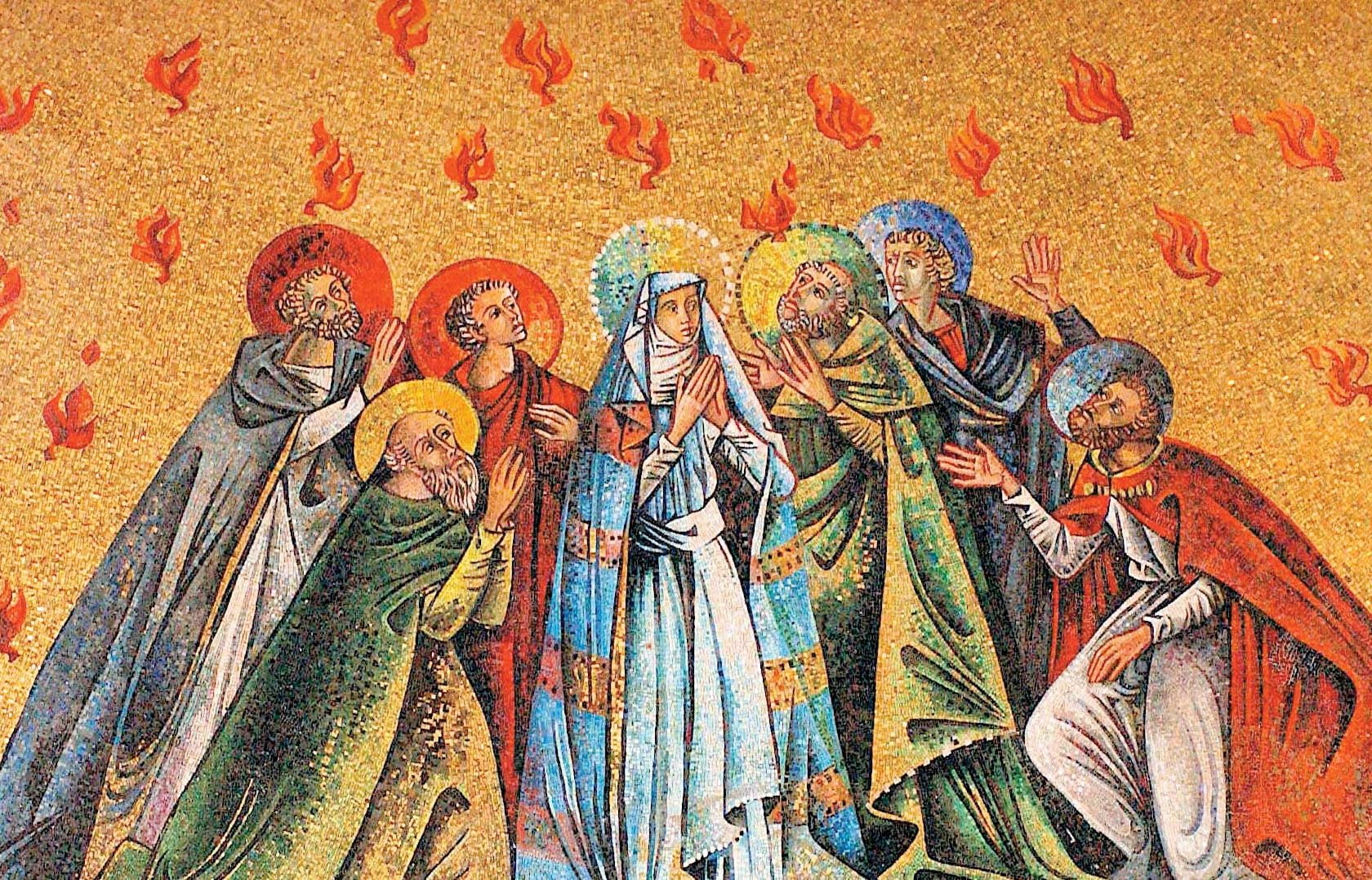
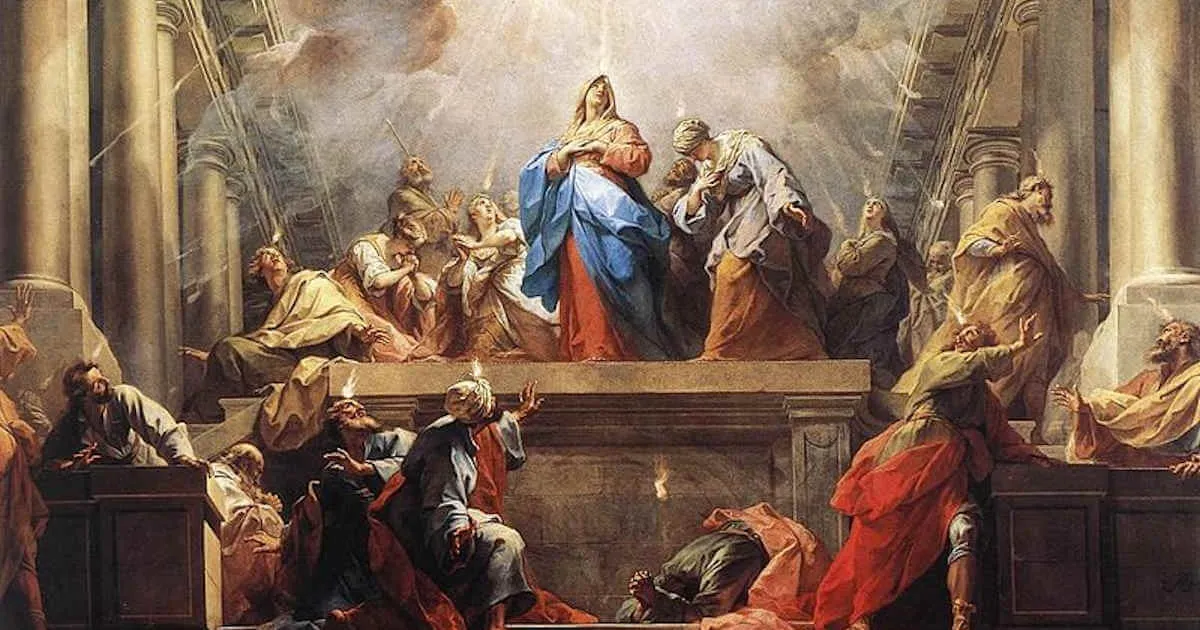
  • Acts recounts the dramatic outpouring of the Holy Spirit upon the tiny, newborn Church gathered in the upper room in Jerusalem.
  • The Holy Spirit came as wind and fire, and gave the Apostles words which moved the hearts of the Jews from all over who were on pilgrimage to Jerusalem. The pilgrims heard the Apostles in their own native languages.

Ps 104:1, 24, 29-30, 31, 34

  • We are looking for a renewal—from the death of sin to the life of grace, from the death of the body to the body’s glorious resurrection. This is why we ask God to “send forth your spirit,” so we can be created anew the way spring renews the face of the earth.

Rom 8:8-17

  • Although we have the freedom to go back to our old way of living “according to the flesh” if we want that, by Baptism we have the Holy Spirit and can live accordingly.
  • The Holy Spirit makes us adopted children of God, sons and daughters who really are his heirs and who can call on the Father the way Christ did: “Abba, Father.”
  • We are not slaves of God, who must fearfully submit to him, but sons.
  • And what is the inheritance we will receive his as sons and daughters? It is to have glorified eternal life with Christ, “if only we suffer with him” now.

Jn 14:15-16, 23b-26

  • The indwelling of the Blessed Trinity in the soul of the baptized Christian in a state of grace lets him call out, “Abba, Father!”
  • Christ’s promise that he and the Father will come to the Christian and make their dwelling with him is precisely the indwelling of the Holy Spirit who teaches us what we need to know.
  • The Holy Spirit also gives us the ability to love, which includes the ability to love Christ by keeping his commands.

Doctrine: Love and the Holy Spirit

  • “God’s love has been poured into our hearts through the Holy Spirit” (Rom 5:5). (CCC 733)
  • The first effect of this love is the forgiveness of sins, restoring “to the baptized the divine likeness lost through sin” (CCC 734).
  • The Holy Spirit gives us the gift of divine love, the ability to love as God loves us. This love is the very life of the Blessed Trinity. This ability to love is the “power” proper to Christians. (CCC 735)
  • From this power to love grows the fruits of the Holy Spirit as we renounce ourselves and walk in the Spirit: love, joy, peace, patience, kindness, goodness, faithfulness, gentleness, self-control.” (CCC 736)
  • The Holy Spirit teaches us how to pray (CCC 741).

Practical Application: A Prayer to the Holy Spirit

  • Something concrete which is always useful is to memorize, understand, and pray with faith a verbal prayer to the Holy Spirit such as this one:

Come Holy Spirit, fill the hearts of your faithful and kindle in them the fire of your love. Send forth your Spirit and they shall be created. And You shall renew the face of the earth.

O, God, who by the light of the Holy Spirit, did instruct the hearts of the faithful, grant that by the same Holy Spirit we may be truly wise and ever enjoy His consolations, Through Christ Our Lord, Amen.

  •  This prayer calls to mind the fundamental things the Holy Spirit gives us:
    • Renewal
    • Divine love
    • Instruction
    • Wisdom
    • Consolation
  • We can recite this prayer upon rising in the morning, at the beginning of a time of prayer or spiritual reading, before Mass, before beginning any work, including study and our professional work.
  • It is a way of dealing with the Holy Spirit individually as the person he is.
If you enjoyed this article, Get email updates (It’s free)

Solemnity of the Ascension of the Lord – May 12

Benvenuto_Tisi_da_Garofalo_-_Ascension_of_Christ_-_WGA08474Central Idea: Jesus Christ is now our High Priest in heaven. Doctrine: The Ascension. Practical Application: Confidence that we can reach heaven.

To view the readings for Lectionary 58 click here.

Central Idea: Jesus Christ is now our High Priest in heaven.

Acts 1:1-11

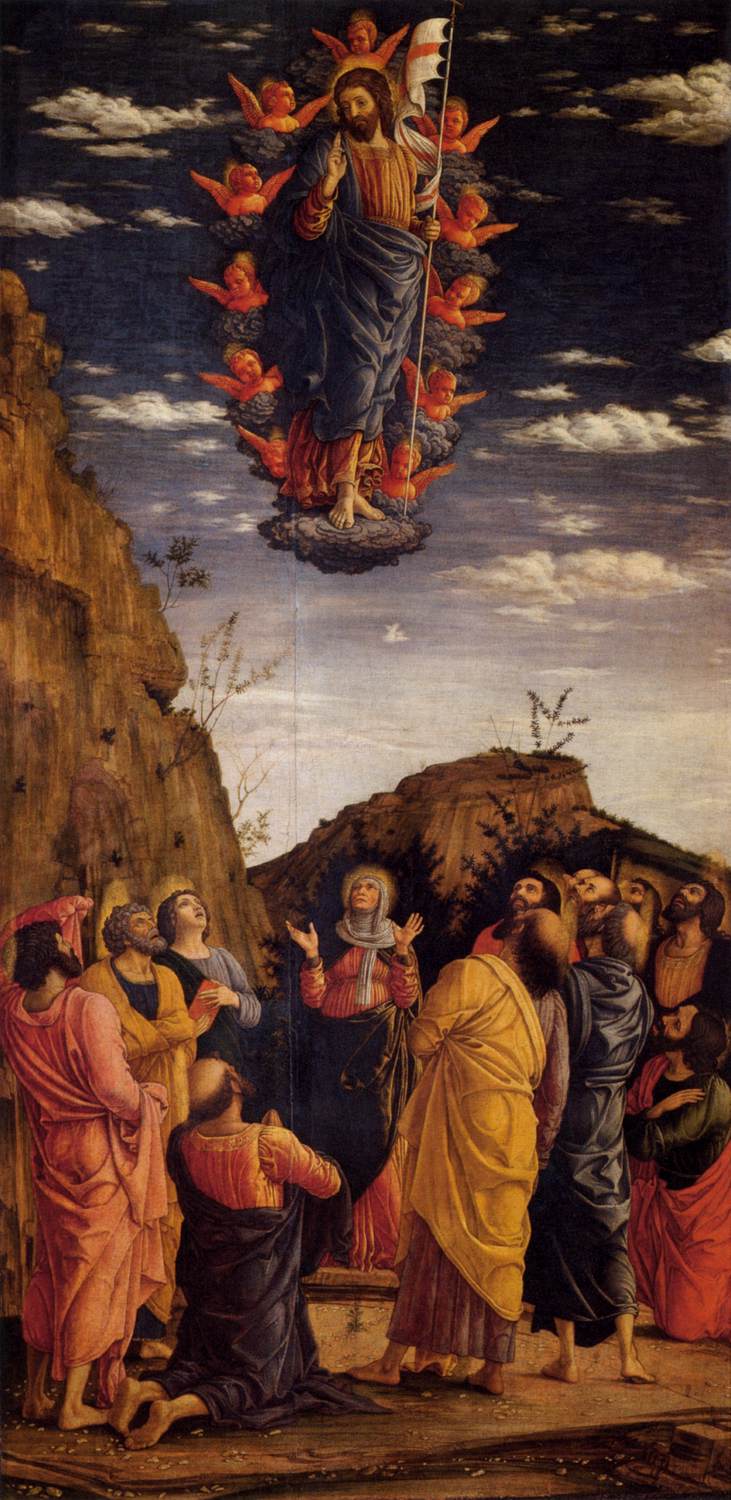
  • In the forty days between Christ’s Resurrection and Ascension, he appeared many times to his disciples and Apostles, showing them he was alive and teaching them.
  • He promised to send them the Holy Spirit. Then they were to be his witnesses throughout the world, beginning in Jerusalem.
  • Then he was lifted up into heaven and a cloud took him from their sight.

Ps 47:2-3, 6-7, 8-9

  • It seems built into human beings to admire and honor their leader. Presumably, there is a reason he got to the position he has reached.
  • It is also right to be skeptical about leaders. It is just as likely they are cynical, unjust, power-hungry thieves as they are prudent, just, courageous, and strong heroes.
  • But Jesus Christ our King and Lord is supremely worthy of our honor. He is the sum total of every good quality that has ever been or could ever be found in a human being. He has done great, heroic deeds to get where he is. And good King that he is, Christ uses his powers only to benefit us.
  • So while it is appropriate to honor the office and to salute the rank of those over us here on earth, it is usually foolish to actually glorify them, unless they have really done something worthy of this adulation.
  • But with Christ, it is right to be joyful in his presences and to give him thanks and praise as the Psalm indicates. It is right to give him latria, or the worship due to God.

Heb 9:24-28; 10:19-23

  • The author of the Letter to the Hebrews gives us complicated but valuable doctrine. He draws parallels between the Temple of Jerusalem and the Jewish high priest and heaven and Jesus Christ.
  • In the Temple of Jerusalem was the sanctuary where the Ark of the Covenant was kept. Once a year, the high priest entered this Holy of Holies and sprinkled blood from a sacrificed animal on behalf of God’s people for the forgiveness of their sins.
  • Through his Ascension, Christ our High Priest enters heaven, the true sanctuary of which the earthly one in Jerusalem is just a copy. There, Christ offers his sacrifice to God the Father for our sins.
  • As our high priest in heaven, Christ is ever ready to intercede for us so we can obtain forgiveness of sins and everlasting life.
  • We can enter Christ’s sanctuary by way of his flesh and blood with bodies washed clean with water. In other words, salvation comes to us through the Sacraments of Baptism and then the Holy Eucharist.

Lk 24:46-53

  • Christ’s own mandate was that his Church, through the assistance of the Holy Spirit, would preach to the world everything he had done and taught, especially his Death and Resurrection and the necessity of repentance for the forgiveness of sins.
  • But the Church is no abstract entity. Only concrete human beings can be Christ’s witness on earth. This duty to evangelize belongs to every follower of Christ. Today the duty falls with bishops, priests, and deacons. It also falls on the laity: Every one of us.

 Doctrine: The Ascension

  • In the Nicene Creed we will proclaim what we just heard: Our Lord “ascended into heaven and is seated at the right hand of the Father.” What does it mean to “ascend into heaven” and to be “seated at the right hand of the Father”?
  • Christ’s body was glorified at the moment of his Resurrection. But when he appeared afterwards to his disciples, he kept his full glory veiled. Now Christ enters heaven where his full glory shines forth. On the road to Damascus, St. Paul got a glimpse of this post-Ascension glory. (CCC 659)
  • Christ’s Ascension or going up to heaven completes his Incarnation or coming down to earth. Christ has opened the way to heaven for us. (CCC 661). “Jesus Christ, the head of the Church, precedes us into the Father’s glorious kingdom so that we, the members of his Body, may live in the hope of one day being with him for ever” (CCC 666).
  • By ascending from earth to heaven, Christ did not just open a way for us to follow as best we can. Christ promised his disciples, “And I, when I am lifted up from the earth, will draw all men to myself.” His lifting up, first on the cross, then from the dead, and now by his Ascension, begins his work as eternal priest of the new and everlasting covenant. He “entered, not into a sanctuary made by human hands … but into heaven itself, now to appear in the presence of God on our behalf.” There, Christ permanently exercises his priesthood, for he “always lives to make intercession” for “those who draw near to God through him.” (CCC 662) “Jesus Christ, having entered the sanctuary of heaven once and for all, intercedes constantly for us as the mediator who assures us of the permanent outpouring of the Holy Spirit.” (CCC 667)
  • “By ‘the Father’s right hand’ we understand the glory and honor of divinity, where he who exists as Son of God before all ages, indeed as God, of one being with the Father, is seated bodily after he became incarnate and his flesh was glorified.” (CCC 663)
  • “Being seated at the Father’s right hand signifies the beginning of the Messiah’s kingdom, the fulfillment of the prophet Daniel’s vision concerning the Son of man: ‘To him was given dominion and glory and kingdom, that all peoples, nations, and languages should serve him; his dominion is an everlasting dominion, which shall not pass away, and his kingdom one that shall not be destroyed.’”  (CCC 664)

Practical Application: Confidence that we can reach heaven.

  • Christ ascended into heaven. He opened the way for us to get there. There his glory is fully revealed. There he acts as high priest of the New Covenant. There he draws all men to himself.
  • Can anything be “done” with the doctrine of the Ascension? Is it just a collection of related truths to be believed, doctrines that can’t have any impact on our lives? No. These realities can affect our lives positively. The author of the Letter to the Hebrews tells us how:

[S]ince through the blood of Jesus we have confidence of entrance into the sanctuary by the new and living way he opened for us through the veil, that is, his flesh, and since we have “a great priest over the house of God, “let us approach with a sincere heart and in absolute trust, with our hearts sprinkled clean from an evil conscience and our bodies washed in pure water. Let us hold unwaveringly to our confession that gives us hope, for he who made the promise is trustworthy.

  • Words like confidence, absolute trust, and hope can become real to us. Christ is. He is in heaven. The way he has opened to heaven is himself. It is made concrete on earth through his Church. His Sacraments can get us there. We will be able to be there with him soon.
  • The Apostles and hundreds of other followers of Christ saw the risen Lord. The Apostles saw him ascend into heaven. They were certain that he was in heaven acting on their behalf, drawing people to himself for their salvation.
  • We are those, on the other hand, who are blessed because we have not seen and yet believe (Jn 20:29).
  • We can say to him, Show me that you are and that you care. Make it clear to me that you really are on that far end of the way. The heaven-side of the way.
  • We who are on the earth-side of the way can also say, “I’ll do my part,” and do it. I’ll talk to you in prayer. I’ll worship you in the Mass. I will receive you in the Eucharist. I will struggle every day to do your will, including living the moral life you demand, and go to Confession to deal with my failures. I will try to be like you, going about doing good (Acts 10:38).
  • If we do this, according to the testimony of the saints, pretty soon Christian confidence, trust in Christ, and hope become real.
If you enjoyed this article, Get email updates (It’s free)

Sixth Sunday of Easter – May 5

The AngelusCentral Idea: God wills only good for us, not a burden. Doctrine: The will of God. Practical Application: Doing the will of God daily.

Click here for the readings for Lectionary 57.

Central Idea: God wills only good for us, not a burden.

Acts 15:1-2, 22-29

  • The first reading recounts what led up to and followed the Council of Jerusalem, in which the Apostles and elders took up the controversial question of whether Gentile converts in the newly established churches had to follow the Law of Moses.
  • They made a momentous decision in interpreting the Deposit of Faith that it was not necessary to burden converts with the 613 precepts of daily Jewish living.
  • They were confident that it was not just their own decision but that of the Holy Spirit. They gave their emissaries Judas Barsabbas and Silas the mandate to instruct those missionary churches orally and in writing.
  • The Apostles and their successors—the Pope and the bishops in communion with him—have the power to know the decision of the Holy Spirit. As Christ had instructed his Apostles, “the Advocate, the Holy Spirit, whom the Father will send in my name, will teach you everything and remind you of all that I told you” (Jn 14:26).
  • As the Catechism points out, the Church is a visible society with a visible hierarchy (CCC 837). Peter and the Apostles and the elders they appointed can teach with authority because of the Holy Spirit.

Ps 67:2-3, 5, 6, 8

May the nations be glad and exult because you rule the peoples in equity.

  • It was the mission of Israel, and is now the mission of the Church built on the Apostles, to make “known upon earth . . . among all nations” God’s salvation.

All authority in heaven and on earth has been given to me. Go therefore and make disciples of all nations, baptizing them in the name of the Father and of the Son and of the Holy Spirit, teaching them to observe all that I have commanded you; and lo, I am with you always, to the close of the age. (Mt 28:18-20)

  • God expects a lot from his people, but his expectations are not burdensome. He rules the people in equity, that is, fairly and mercifully. We just saw this in the Apostles’ and the Holy Spirit’s decision not to impose the observance of the Mosaic Law on Gentile converts.
  • Whenever you feel that what God or his Church is asking of you is too much, you should ask yourself, is it God and his Church or is it me?
    • Jesus Christ does put a yoke on us, that is, he does demand we live a certain way, but he quickly adds, “My yoke is easy and my burden light.” We see this in the decision given to the Gentile converts.
    • Sometimes we desperately want something. It could be something contrary to the Gospel, including something contrary to the moral law. It could also be something good but impossible for us, beyond our capacity or talents. When we push against God or against reality, something easy becomes very hard.
    • God in his patient wisdom sometimes lets us remain in this condition until we come to our senses. God knows that sometimes the solution to a problem is the passing of time.

Rev 21:10-14, 22-23

  • St. John presents to us the vision God gave him of heaven or the New Jerusalem. It is filled with light, rich, beautiful, strong, and secure. It welcomes all of humanity by way of Israel and the Apostles. It is God dwelling with mankind.

Jn 14:23-29

  • This Gospel reading records some of Jesus’ most intimate and heartfelt instruction to his Apostles at the Last Supper.
  • Loving Christ requires obeying his word and results in the indwelling of the Blessed Trinity: The Father and the Son and Holy Spirit “will make [their] dwelling” with the one who does this. So this reading is about the life of grace in our soul. If you are baptized and are in a state of grace, the Father, the Son, and the Holy Spirit dwell in you as in a temple.
  • The Blessed Trinity in a sense “possesses” us. Not in the way demons do, dominating a person’s mind and will, making him miserable. The Blessed Trinity possesses us a way that totally respects human freedom and that leads the person to overcome his futile thoughts and attachment to sin, shouldering his own cross everyday. God’s indwelling is gentle, hidden, but real now, but one day it will be all “communion and feast” (CCC 1136).
  • Christ promises to confirm the Apostles in all truth through the sending of the Holy Spirit, which would occur on Pentecost.
  • We desire to love Christ. Who is more loveable? Yet love is not a feeling. Love of Christ means obedience to him, which is the same as obedience to the Father.
  • To some extent, obedience to God by keeping the word of Christ is in our power because of the grace he gives us. So is the power to not be troubled or afraid because of the gift of peace that Christ leaves behind.

Doctrine: The will of God.

Thy will be done, not my will be done.

  • What is God’s will? It is to save us by our loving one another (CCC 2822).
  • Jesus Christ, the Son of God, perfectly fulfilled the will of his Father (CCC 2824). That is what God has done to save us.
  • Through God’s gift of grace we can unite our wills to Christ’s perfect will and do what he did: love one another as he has loved us (CCC 2825).
  • Prayer is an indispensible requirement for doing God’s will, for “By prayer we can discern ‘what is the will of God’ and obtain the endurance to do it. Jesus teaches us that one enters the kingdom of heaven not by speaking words, but by doing ‘the will of my Father in heaven.’” (CCC 2826)
  • Christ is the way to the will of God. The saints and especially the all-holy Mother of God can intercede for us, those “who have been pleasing to the Lord because they willed his will alone” (CCC 2827).

Practical Application: Doing the will of God daily.

  • How can we know God better and love one another so as to obtain salvation?
  • Prayer. To do God’s will we must become men and women of prayer. If you know God through prayer you will love him and want to do his will. Here are some common forms of prayer (there are many more):
    • A morning offering of your day to God.
    • An examination of conscience at the end of the day.
    • Night prayer before going to sleep.
    • Vocal prayers like the Our Father and the Rosary.
    • Mental prayer when we talk to God directly.
  • Spiritual reading. Read the Gospel and some sound spiritual book for a few minutes every day to get to know God.
  • The Mass. (Even daily Mass!) The Mass is the perfect prayer and act of thanksgiving, reparation, adoration, and petition. It is a way of hearing the Word of God. We receive the Body and Blood of Christ and so the grace to obey the Father by loving one another.
  • Aspirations. Perhaps the best aspiration we can repeat throughout the day whenever we face contradictions to our own will is “Thy will be done.” All day long we face the urge to do what presents itself to us as pleasing. We also face the urge to avoid what appears displeasing. And quite often we are “stuck” in a situation in which we are being compelled to do what we don’t want to do. This is where the prayer, “Thy will be done,” bears fruit.
  • Thanksgiving. Quite often, God’s will and our will coincide, even if only after the fact. “Father, I am happy that I experienced and endured that difficulty and want to offer that to you.”
  • Service. The essence of God’s will for us is to serve others.
    • Every activity above can be turned from self-focused to other-focused by offering it for the sake of another.
    • Every other activity of the day can be offered for others.
    • Most of them can be done in direct service to others, just as at this moment I am typing these words for the benefit of anyone who reads them or will hear them who can be benefited by them.
If you enjoyed this article, Get email updates (It’s free)

Fifth Sunday of Easter – April 28

new_jerusalem_pic

Central Idea: If you “love one another as I have loved you,” then heaven has come down to earth. Doctrine: Christ’s New Commandment. Practical Application: Living the New Commandment.

To view the readings, click here. (Lectionary: 54)

Central Idea: If you “love one another as I have loved you,” then heaven has come down to earth

Acts 14:21-27

  • The first reading recounts the first missionary journey of the Apostles Paul and Barnabus, preaching the Gospel mostly to Gentiles.
  • It is successful because people say yes to their message.
  • First Paul and Barnabus went out and made converts. Retracing their steps, they strengthened the faith of the new churches and left elders in charge.

Ps 145:8-9, 10-11, 12-13

I will praise your name for ever, my king and my God.

  • The prayer of the psalm is that God’s faithful will make known to the “children of Adam” God’s might and “the glorious splendor of [His] kingdom.”
  • It is good to be in a state of holiness, that is, to be in a right relationship with God. It is good now as we live on the earth in faithfulness to God’s will. And it will be even better when God’s reign in our lives is complete in the glorious splendor of his eternal kingdom.

Rev 21:1-5a

Behold, God’s dwelling is with the human race. He will dwell with them and they will be his people.

  • Some have disparaged Christianity by calling it wish fulfillment. I don’t know what is wrong with having your wants and needs met.
  • We want God to exist. We want God to be good. We want to be with God. We want to be perfectly happy. We want to be in a perfectly beautiful place. We want to be perfectly beautiful ourselves. We want to have indestructible bodies, incapable of pain. We want there to be no more death or tears. We want to be reunited with all the people we love and to be with all who are loveable.
  • The psalm speaks of the glorious splendor of God’s kingdom and St. John gives us a glimpse of it in the new creation crowned by the New Jerusalem in which God himself will dwell with his people.
  • We tend to think of salvation in terms of us going up to heaven where God dwells. But God renewed creation when he came down to the earth in the Incarnation. In the renewal of creation of which St. John speaks, heaven will again come down to earth in the New Jerusalem, the glorious City of God on earth in which God dwells with us.

Jn 13:31-33a, 34-35

  • Since the moment of the Incarnation, God the Father has glorified or honored this divine-human person, Jesus Christ. But now, the honor in which each holds the other will be proven as the Son lays down his life for the salvation of humankind.
  • This goes hand in glove with the New Commandment which Our Lord now reveals to his disciples: To love with a sacrificial love.
  • If we want to give glory to the Blessed Trinity, we just have to love one another even if it hurts.

Doctrine: Christ’s New Commandment

  • Christ reveals this New Commandment to his closest disciples at the Last Supper. This command is not “one more thing” to do. It is the one thing to do. It is the one command that sums up the two commandments (to love God and neighbor), that encompasses the Ten Commandments, that summarizes the entire moral law.
  • We are to love each other. What is the love we are talking about? It is willing the true good of another. A loving act is one which seeks to give true good to another.
  • This definition of charity may be startling if you have never thought about it before, but it is not the new part of the New Commandment. What is new is that the model for loving one another is the way Christ loved. How did he love? He laid down his life in the most painful, gruesome death. So, real love is love until it hurts. It is a sacrificial love. So the New Commandment is to love one another with a sacrificial love.
  • Like many great truths, it is hidden before you grasp it, but once you do it is totally obvious. It is what mothers and fathers do for their families, what true friends do for one another, what soldiers do for their cause, what artists do for their art.
  • This same mode of love is how Christ glorifies or gives praise or honor to his Father and how the Father is the very most pleased with his Son.
  • So we can summarize the entire moral law and the entire mode of living of a follower of Christ in this New Commandment: Love one another with a sacrificial love.
  • One might object and say, that’s masochistic. You sick people love being martyrs. No. It is just the way love is in this world. Doing the right thing for another, acting for another person’s true good is often hard because we are selfish, pleasure-seeking, weak, angry, clannish, vengeful, indifferent, and more. When you are first in love you might be willing move a mountain for the other, but as time goes on, you might only need to move a grain of sand and that seems too great a bother.
  • We might think of heaven as a place of great beauty and happiness of every kind, a place where the saints, spiritual champions, dwell. It is that. But it is really the place where love dwells.

Practical Application: Living the New Commandment

  • Because the New Commandment is sacrificial love, there are two parts to living it. The first is knowing what is the loving thing to do. Usually this is obvious and requires little or no thought. If your child is sick, you take care of him. If your elderly neighbor is struggling to carry something, you offer to help her. If you are getting up to get more coffee, you ask your spouse if she would like more. Some people are experts at making other people happy by giving of themselves.
  • However, sometimes it is actually hard to know what the right thing to do is. Should you quit your job because it is hurting your family life? Should you pick up and move somewhere else for the sake of your family? What should your profession be so you can best serve others? Or, what if a friend needs to be confronted about his behavior? How will you approach this without destroying your friendship and making things worse? So to love, we need prudence and justice. Justice is giving others what you owe them and Christ is saying we owe each other love. Prudence is sound decision-making. In this case, it tells us what love would do.
  • The second part of living the New Commandment is making the sacrifice. Doing the true good of the other will cost us a tiny amount or a great deal. This is where the virtues of temperance and fortitude are vital. Temperance is the habit by which we postpone or forgo some pleasure for a good reason. Fortitude is doing the right thing even though it might be hard or we might be afraid to. This is one reason the Church gives us forty days of Lent every year and why she asks us to practice a little Lent every Friday. When you give up meat or chocolate or pray the Rosary on your knees before the Blessed Sacrament, or whatever you do, it is not that you are doing something heroic or especially meritorious. It is mostly that you are thwarting your own selfish will, which is exactly what you need to make a sacrifice when love calls for it.
  • If love is the game, then the ascetical life is the training, calisthenics, coach, and practice sessions we need to play that game.
  • When we love one another–and this takes sacrifice–not only do we fulfill the New Commandment, we make a little bit of heaven present on earth.
If you enjoyed this article, Get email updates (It’s free)

Fourth Sunday of Easter – April 21

Good Shepherd septiaCentral Idea: Christ is the Good Shepherd and we are his lambs. Doctrine: The virtue of courage. Practical Application: Growing in courage.

To view the readings, click here. (Lectionary: 51)

Central Idea: Christ is the Good Shepherd and we are his lambs.

Acts 13:14, 43-52

  • Christ came into the world in the fullness of time.
  • Part of why this was such a good time for God to carry out his plan of salvation was that his Chosen People, the Jews, had been preparing the Roman Empire for this very message.
  • Jews lived in every city of the Empire, making up an estimated ten percent of the population.
  • Many Gentiles learned about the One, True God, the Sacred Scriptures, the Mosaic Law, and the Covenants from them.
  • They made direct converts, as Acts mentions.
  • There were also “righteous Gentiles,” also called “proselytes at the gates,” people who were attracted to Judaism but were not ready to live as Jews.
  • Thus, Paul and the other Apostles found a ready-made audience for the Gospel.
  • Paul and Barbabus were able to fulfill Isaiah’s words about God’s messenger bringing light to the Gentiles. This is what Paul and Barnabus were doing:

I have made you a light to the Gentiles, that you may be an instrument of salvation to the ends of the earth.

  • Nevertheless, this took courage, as they faced constant rejection.

Ps 100:1-2, 3, 5

  • We are God’s people, the sheep of his flock.
  • Is being a flock of sheep such a good analogy for being a member of the Church?
  • If we are humbly honest, we will admit that most of us for most of our lives are not that smart, not that strong, not that brave, have enemies who would hurt us, are made to live together in a community, and need a strong and good protector who loves us.
  • If Jesus Christ is our Good Shepherd, I’ll be happy to be one of his sheep. How about you?

Rev 7:9, 14b-17

  • John’s vision is a picture of heaven.
  • Some people think only a few people are saved. But John sees “a great multitude, which no one could count.”
  • The salvation of Christ, the Good Shepherd and Lamb of God, is universal not in the sense that everyone is saved (since some refuse) but that it is not exclusive to any one people. It can include any human being, for the crowd John sees is made up of persons of “every nation, race, people, and tongue.”
  • They wear “white robes” and hold “palm branches,” symbols of their redemption from sin and death.
  • John describes heaven negatively, which is appropriate after a “time of great distress”: No hunger, thirst, oppressive heat, or tears.
  • Some humorists, cynics, nihilists, and atheists argue that heaven doesn’t sound very fulfilling since the redeemed “stand before God’s throne and worship him day and night in his temple,” making heaven a perpetual church service.
  • A point in the Catechism about the heavenly liturgy can be eye-opening.

“Liturgy is an “action” of the whole Christ (Christus totus). Those who even now celebrate it without signs are already in the heavenly liturgy, where celebration is wholly communion and feast.” (CCC 1136)

  • In other words, liturgy is the activity of the Body of Christ. We celebrate the heavenly liturgy here on earth with signs. In heaven this activity will be direct. The Catechism tells us it will be “wholly communion and feast.” It means being together with your family and having a better celebration than you can ever imagine. In heaven, your “family” includes God, the angels, your loved ones, really everyone who is loveable.

Jn 10:27-30

  • When our Lord says no one can “take” his own sheep out of his hand and no one can “take” them out of the Father’s hand, he is referring to wolves snatching sheep, or thieves and robbers, or dangerous strangers who want to harm us.
  • Jesus spoke these words in the Temple in Jerusalem to Jewish men who knew and practiced their faith. Many of them wanted to stone Christ to death for blasphemy, for making himself equal to God. Consider the meaning of Our Lord’s words:

“I give them eternal life.”

“The Father and I are one.”

  • The Jewish authorities would be right to be furious with Jesus, except that he was telling the truth.
  • If Jesus’ words are true—we believe they are—then we are not just going to get eternal life. Rather, we already have eternal life, even if we have to struggle and to pass through physical death. If we have eternal life, eternal life has already begun. Then just what are we afraid of? If we stay close to Christ, who can really harm us?
  • This earth is a dangerous place, because it is filled with wolves: Thieves, murderers, liars of every kind. But we are in the safe sheepfold. The sheepfold is the Church. We can go out into the fields, into the world, and be safe, because our shepherd is the Good Shepherd.

Doctrine: The virtue of courage

  • We may be Christ’s lambs, but we ought to be courageous lambs. Maybe even lambs with the hearts of lions.
  • Courage is first a natural, human virtue which any person can develop by practice.
  • Courage is doing the right thing even though one is afraid, like Marines who are trained to run toward the sound of gunfire. Cowardice is the lack of courage, such that one does not do the right thing out of fear, like the teenager who does not go to the prom with the girl of his dreams because he is too afraid to ask her. Courage also has a warped excess called foolhardiness in which one takes crazy risks unnecessarily, like supposed followers of Christ who tell themselves mortal sins are not mortal sins, or not even sins at all, and then commit them.
  • For the Baptized, courage is a supernatural virtue. One reason is that “the right thing” to do for a Christian should always be what God wants done. Another is that God helps us accomplish what we otherwise could not with his grace.
  • Paul and Barnabus, as Apostles, were doing the right thing, what God wanted them to do, which was to bring the Gospel to Jews and Gentiles to the ends of the earth, despite how dangerous this was to do.

Practical Application: Growing in Courage

  • What am I afraid of which keeps me from doing what I should? Do I tend to be more fearful or reckless? A first step to growing in courage is to get to know yourself and what God is asking you. Thus, vocation (married or single) and roles (employer, student, parent) are also important in self-knowledge.
  • Our Faith promises us that nothing truly bad can ever really happen to us if we stay united to Christ, our good shepherd, because he has already given us eternal life. Still, we experience lesser and greater fear all the time while we are in the world.
  • Make an inventory of tasks you are normally supposed to perform and situations you often face which make you even a little afraid or which you attack with recklessness.
  • Examples of scary things could be driving on the freeway, making sales calls, telling your spouse something unwelcome, correcting or disciplining children, or making a customer complaint.
  • Examples of foolhardiness might be speeding, not following directions, being argumentative with people in authority, or not checking ratings on movies before starting them.
  • Don’t be surprised if your examples only fall into one column or the other.
  • Then take small steps. Choose something which is the right thing to do and then do it. If it is to make a phone call (cowardliness), do it immediately, as early as possible, rather than putting it off and then not doing it. If it is not speeding (foolhardiness), set the cruise control. In both cases, offer the act to God. “God, I’m making this phone call for you.” “God, I’m not passing people up for you.”
If you enjoyed this article, Get email updates (It’s free)